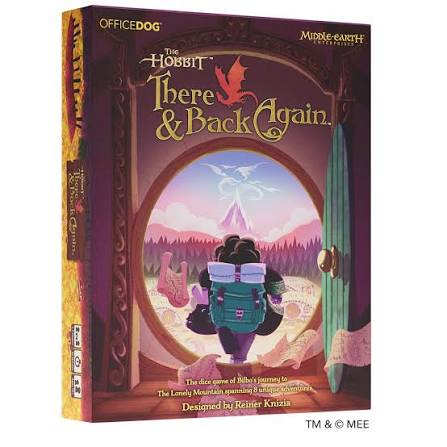
The Hobbit: There and Back Again
The Hobbit: There and Back Again
Cantrip Cards and Games
Couldn't load pickup availability
Tolkien x Knizia x markers… That mashup alone was enough to send us sprinting to the table. Reviewers have been raving, we’ve played it more than eight times ourselves, and at first glance it even feels like a contender for game of the year.
Should You Buy It? Our Conflicted Answer
So should you buy it? Well, initially our answer was no. But then we second-guessed ourselves: how can you not recommend a game that made you feel warm, excited, and angry all at once? Which is how we landed in this strange middle ground: we adore it, we see its flaws, and somehow we recommend it anyway.
Charm, Theme, and That Tolkien Pull
The Hobbit: There & Back Again is fantastic in so many ways: charming, thematic, gorgeous on the table, and quick enough to teach in five minutes flat. We loved chasing new chapters night after night, replaying scenarios where one of us got absolutely wrecked, and soaking up all the Tolkien flavour sprinkled across the campaign.
But here’s the conundrum: that joy came less from clever strategy, and more from the thrill of discovery and the pull of Tolkien’s world. Once the curtain lifted and the efficiency puzzle was cracked, some of the magic slipped away.
Roll, Draft, Draw… and Sometimes Wait
The rhythm of roll, draft, draw, starts out exciting, especially at two players where you can be deliciously cutthroat; anticipate your opponents choices and deny them their rewards. Some scenarios shine, with chunky shapes to carve clever routes and plenty of ways to optimize. In those, our boards ended up looking wildly different, little mementos of our shifting strategies.
But others… not so much. Parts Two and Three in particular dragged, with single obvious “best routes” that offered little agency. And when you need very specific rolls to make progress, that shift from I’m solving a puzzle to I’m waiting for luck, made us feel less like we were steering the game and more like we were being puppeted through it.
And Yet… We Kept Playing
Even when chapters frustrated us, we still wanted to see what was next. That’s the odd contradiction here: it can be both brilliant and flat in the same breath.
Completionist Heartbreak
The hardest part was realizing that sometimes the optimal path wasn’t to fulfill your completionist urge. You want to save every dwarf, stockpile bread, and nab all the points, but often the smarter move was to abandon the urge and just race to finish. Our hearts broke a little every time we realized that.
Replay Worth Chasing
Some chapters begged to be replayed, especially Part One with its puzzle of balancing bread, rescuing characters, and trying to be clever enough to grab Gandalf and Thorin. But even then, the fun was in squeezing efficiency out of something that, once solved, became predictable. Our decisions always circled back to lore more than gameplay. Luckily, we love Tolkien, so being steered by story rather than depth wasn’t the worst.
Storybooks, Chonky Bits, and Player Aids
Production-wise, it’s hard not to be charmed. Each player gets their own washable storybook, the resources are satisfyingly chonky, and player aids are built right into the pages. The whole package is light, inviting, and friendly; five minutes to teach, quick enough to replay, and never overstaying its welcome.
Rolling Dice vs. Drawing Your Own Path
Of course, the comparisons to Railroad Ink are inevitable. Both translate dice into doodles. But Railroad Ink gives you a blank canvas where everyone uses the same rolls and ends up with wildly different results. Even restrictions like lakes or caverns are yours to place, which is why it’s endlessly replayable.
The Hobbit funnels you instead through predetermined grids and a story. Dice drafting narrows choices, resource bottlenecks hem you in, and more often than not your map resembles everyone else’s. The narrative keeps you moving forward, but doesn’t leave the same space for agency or return visits.
Dazzling the First Time, Predictable the Second
And that’s the paradox of story-driven games. They sparkle on the first pass, dazzling with novelty, but once the curtain’s up, they don’t always invite you back. Replayability isn’t about length; it’s about whether the design creates fresh tension and divergent outcomes each time. Railroad Ink thrives there. The Hobbit doesn’t as much.
Is It Just Cheap Thrills?
At $34.99, you’re essentially paying a few bucks per 20-minute chapter, which feels like fair value even if you never replay it beyond the campaign. For casual players, it’s a cozy one-and-done journey that earns its keep on theme alone. For hobbyists, it’s still worth a whirl, especially when you’re low on spoons and want something breezy yet engaging.
Frustration, Fun, and Filler? Not Quite
So yes, we’ve been harsh. We’ve also been soft. We didn’t want this to be Railroad Ink in Hobbit cosplay, and it isn’t. It borrows familiar tools, reshapes them into a story that means a lot to Tolkien fans, and still gives plenty of laughs along the way. And while we nitpick, we’d be lying if we said we didn’t have a blast comparing maps, cursing each other for drafting “our” die, and squeezing out just enough points to scrape a win. Even the weaker chapters gave us something to talk about. This may be a filler game, but it rarely felt like “just filling time.”